Proper Padlock Keying for Lockout:Tagout
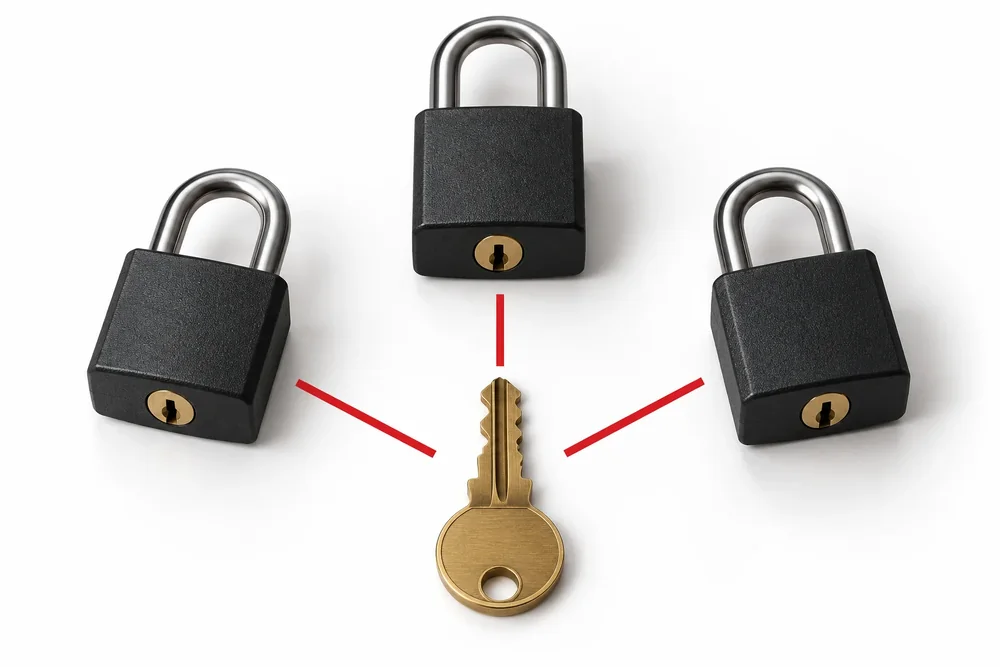
Lockout/tagout protects workers from unexpected startup or the release of stored energy during servicing and maintenance. For U.S. general industry, OSHA's 29 CFR 1910.147 requires an energy-control program with procedures, training, and periodic inspections. An authorized employee must identify and isolate the energy sources, control stored energy, and verify isolation before work begins. A padlock is one part of that process; its color or keying alone does not make equipment safe.
Keyed alike, keyed different, and master keyed
OSHA does not prescribe one keying pattern for every workplace. Lockout devices must be durable, used only for energy control, standardized within the facility by at least color, shape, or size, and marked to identify the employee who applies them. A color scheme can help organize locks, but OSHA does not assign specific colors to trades or departments.
- Keyed different: Each padlock has its own key pattern. This supports individual control when workers use separate personal locks.
- Keyed alike: One key pattern opens a designated set of padlocks. This can help an authorized worker manage multiple isolation points, provided the employer's procedure preserves that worker's control of the locks. It is not a reason for coworkers to share control of one another's personal locks.
- Master keyed: A separate master key can open multiple padlocks in the system. Its existence does not authorize routine removal of another worker's lock. Access to a master key used for exceptional lock removal must be tightly controlled under the employer's documented procedure.
Each worker needs personal protection
When a crew or several departments work on the same equipment, the group procedure must give each authorized worker protection equivalent to a personal lockout device. Each worker attaches a personal lock or tag to the group lockout device, lockbox, or comparable mechanism when starting work and removes it when stopping work. An authorized employee coordinates the job when multiple crews are involved. If contractors participate, the on-site and outside employers must inform each other of their lockout/tagout procedures.
Shift changes require a specific procedure that maintains protection as one crew hands work to another. The incoming worker must have personal protection before exposure; handing over a key or relying only on the departing worker's personal lock is not a substitute. A job or continuity lock may preserve isolation between shifts under the employer's procedure, but it does not replace each exposed worker's personal protection.
Who may remove a personal lock?
Normally, the employee who applied a lockout device removes it. If that employee is unavailable, OSHA permits employer-directed removal only under a documented, trained exception procedure that provides equivalent safety. At a minimum, the employer must verify that the worker is not at the facility, make all reasonable efforts to contact the worker about the removal, and ensure the worker knows the lock was removed before returning to work. OSHA's master-key interpretation allows a master key for this purpose only when the full exception procedure is followed and access to the key is controlled. A supervisor's convenience, a routine check, or an ordinary shift handoff does not by itself justify opening someone else's personal lock.
Before restoring energy, authorized employees must follow the release procedure, check that the equipment and work area are ready, ensure workers are safely positioned or removed, and notify affected employees as required. Key management should support these steps, never bypass them.
This overview concerns general-industry servicing covered by 29 CFR 1910.147. Work involving electrical hazards, construction, or other sectors may be subject to additional or different OSHA rules. Follow the applicable standard and the employer's equipment-specific energy-control procedure.
Sources: OSHA 29 CFR 1910.147; OSHA interpretation on master-key removal; OSHA clarification on continuity locks and shift changes.
Recents Posts
